Why Yirla Exists When Platforms Like Google and LinkedIn Already Offer AI Recommendations
Why Yirla Exists When Platforms Like Google and LinkedIn Already Offer AI Recommendations
Google has been optimizing advertising for more than 25 years. LinkedIn has been refining its ad platform for over 20. Their AI recommendation engines are among the most advanced in the world—trained on trillions of impressions and billions of conversions.
Yirla does not claim to outperform Google or LinkedIn at optimizing their own platforms. That would be an impossible—and unnecessary—argument.
So a reasonable question comes up quickly:
If Google and LinkedIn already offer AI-powered recommendations, why does a product like Yirla need to exist at all?
The answer is not that Yirla is “better” than platform AI. It’s that Yirla solves a different problem—one platform AI is structurally unable to solve.
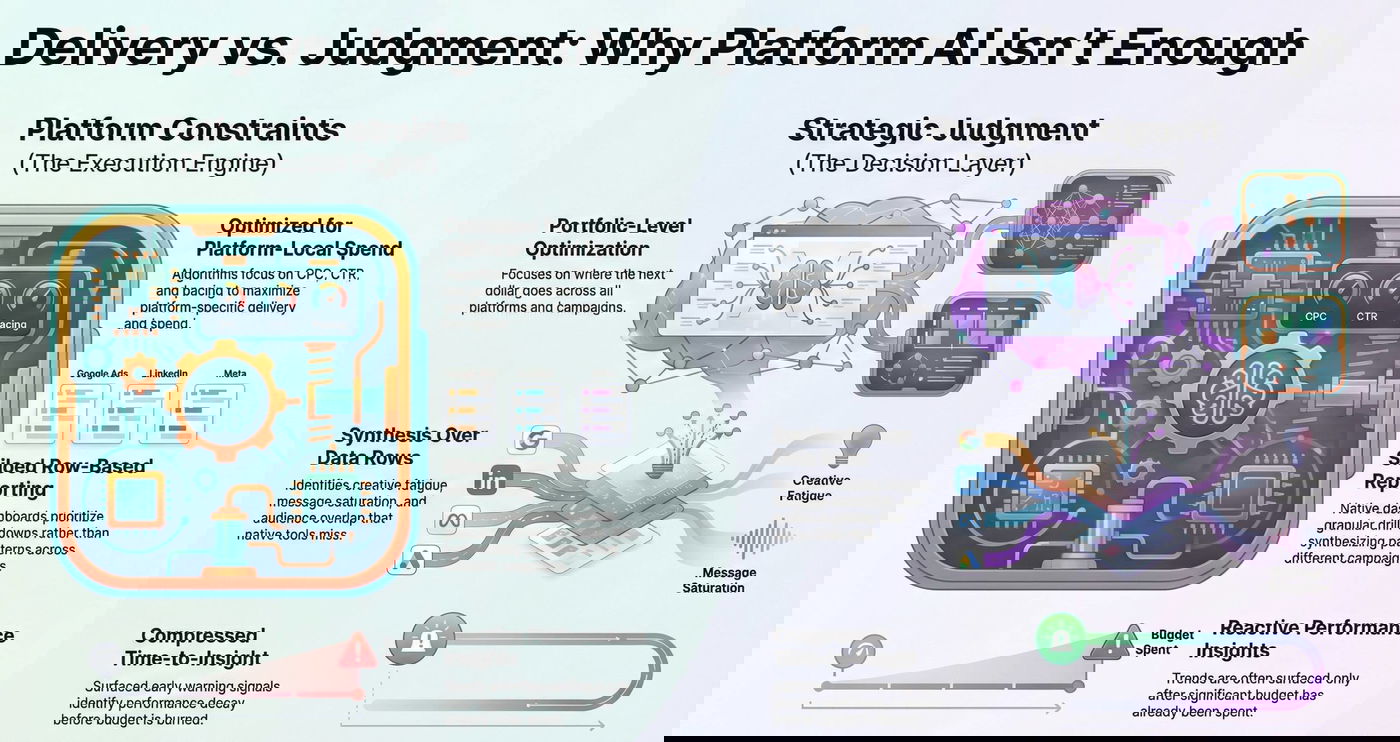
1. Platforms optimize auctions. Advertisers optimize decisions.
Google’s AI optimizes Google outcomes. LinkedIn’s AI optimizes LinkedIn outcomes. Both are evaluated on platform-local metrics such as CPC, CPA, CTR, pacing, and delivery efficiency.
Advertisers, however, care about a different question:
Where should the next dollar go across all platforms, campaigns, creatives, and time?
That is a portfolio-level decision. No single platform has the visibility—or the incentive—to optimize for it.
2. Platforms optimize delivery. Yirla optimizes judgment.
Once a campaign is live, platforms are excellent at deciding how to deliver it. What they cannot tell you is whether the decision to keep running it still makes sense.
Most performance failures don’t come from bad bidding. They come from:
creative fatigue
message saturation
audience overlap
slow recognition of diminishing returns
These are decision-level problems, not delivery problems.
That is where Yirla operates.
3. Platforms show rows of data. Yirla surfaces patterns.
Native dashboards are designed for drill-downs:
campaign → ad set → ad → metric.
They are not designed for synthesis.
Yirla looks across creatives, campaigns, and time to answer questions like:
Is this message being repeated too often?
Has this narrative stopped working category-wide?
Are multiple campaigns competing for the same attention?
Patterns matter more than rows. Platforms don’t surface them. Yirla does.
4. Platforms avoid competitive context. Yirla centers it.
Google and LinkedIn will never tell you:
how your performance compares to competitors
whether CPC increases are market-wide or self-inflicted
whether your creative is late to a trend
Competitive context is intentionally absent from native tools. Yirla is explicitly built to restore it—because without context, performance metrics are misleading.
5. Platforms react after spend is burned. Yirla shortens time-to-insight.
By the time weekly or monthly reports show declining performance, meaningful budget has already been spent. The real value is identifying decay early, while reallocation still matters. Yirla compresses time-to-insight by surfacing early warning signals before performance collapses—not after.
6. Platforms prescribe actions. Yirla provides evidence.
Platform recommendations tend to be generic: increase budget, expand audience, add creatives. They rarely explain why something changed or what trade-offs a recommendation introduces. Yirla shows the creative, the message, the trend, and the context—so decisions can be made and defended in real conversations, not just dashboards.
7. Incentives matter—and they are different.
Platforms benefit when spend increases. That is their business model.
Yirla does not benefit from higher spend. It benefits from clarity.
If platform AI solved this problem, enterprise teams would not still export data into spreadsheets, BI tools, and custom dashboards. Yet they do—because the most important questions live between platforms, not inside them.
Final takeaway
Google and LinkedIn are exceptional execution engines. Yirla exists to make execution intelligible.
Platforms optimize delivery. Yirla optimizes judgment.
That’s why Yirla exists.
1. Platforms optimize auctions. Advertisers optimize decisions.
Google’s AI optimizes Google outcomes. LinkedIn’s AI optimizes LinkedIn outcomes. Both are evaluated on platform-local metrics such as CPC, CPA, CTR, pacing, and delivery efficiency.
Advertisers, however, care about a different question:
Where should the next dollar go across all platforms, campaigns, creatives, and time?
That is a portfolio-level decision. No single platform has visibility into—or incentive to optimize for—that outcome.
2. Platforms optimize delivery. We optimize judgment.
Once you choose to run a campaign, platforms are excellent at deciding how to deliver it. What they cannot tell you is whether the decision to keep running it still makes sense.
Most performance failures don’t come from bad bidding. They come from creative fatigue, message saturation, audience overlap, and slow recognition of diminishing returns. These are decision-level problems, not delivery problems.
That’s where we operate.
3. Platforms show rows of data. We surface patterns.
Native dashboards are designed for drill-downs: campaign → ad set → ad → metric. They are not designed for synthesis.
Our system looks across creatives, campaigns, and time to answer questions like:
Is this message being repeated too often?
Has this narrative stopped working category-wide?
Are multiple campaigns competing for the same attention?
Patterns matter more than rows. Platforms don’t surface them. We do.
4. Platforms avoid competitive context. We center it.
Google and LinkedIn will never tell you how your performance compares to competitors, whether rising CPCs are market-wide, or if your creative is late to a trend.
Competitive context is intentionally absent from native tools. Our product is explicitly built to restore it—because without context, performance metrics are misleading.
5. Platforms react after spend is burned. We shorten time-to-insight.
By the time weekly or monthly reports show declining performance, meaningful budget has already been spent. The real value is identifying decay early, while reallocation still matters.
We focus on compressing time-to-insight—surfacing early warning signals before performance collapses, not after.
6. Platforms prescribe actions. We provide evidence.
Platform recommendations tend to be generic: increase budget, expand audience, add creatives. They rarely explain why something changed or what trade-offs a recommendation introduces.
We show the creative, the message, the trend, and the context—so decisions can be made and defended in real conversations, not just dashboards.
7. Our incentives are aligned with clarity, not spend.
Platforms benefit when spend increases. That’s their business model. We don’t benefit from higher spend—we benefit from better understanding.
If platform AI solved this problem, enterprise teams wouldn’t still export data into spreadsheets, BI tools, and custom dashboards. Yet they do, because the most important questions live between platforms, not inside them.
Google and LinkedIn are exceptional execution engines.
We exist to make execution intelligible.
Platforms optimize delivery. We optimize judgment.
That’s why we exist.