Why Yirla Is Not a BI Tool, CDP, or Attribution Platform
Why Yirla Is Not a BI Tool, CDP, or Attribution Platform
As marketing stacks grow more complex, tools increasingly blur together. BI platforms claim to offer insights. CDPs claim to unify data. Attribution tools claim to explain performance. Yirla is often evaluated alongside these tools—but it is not a replacement for any of them. This article explains what Yirla deliberately does not do, and why that distinction matters.
The short version:
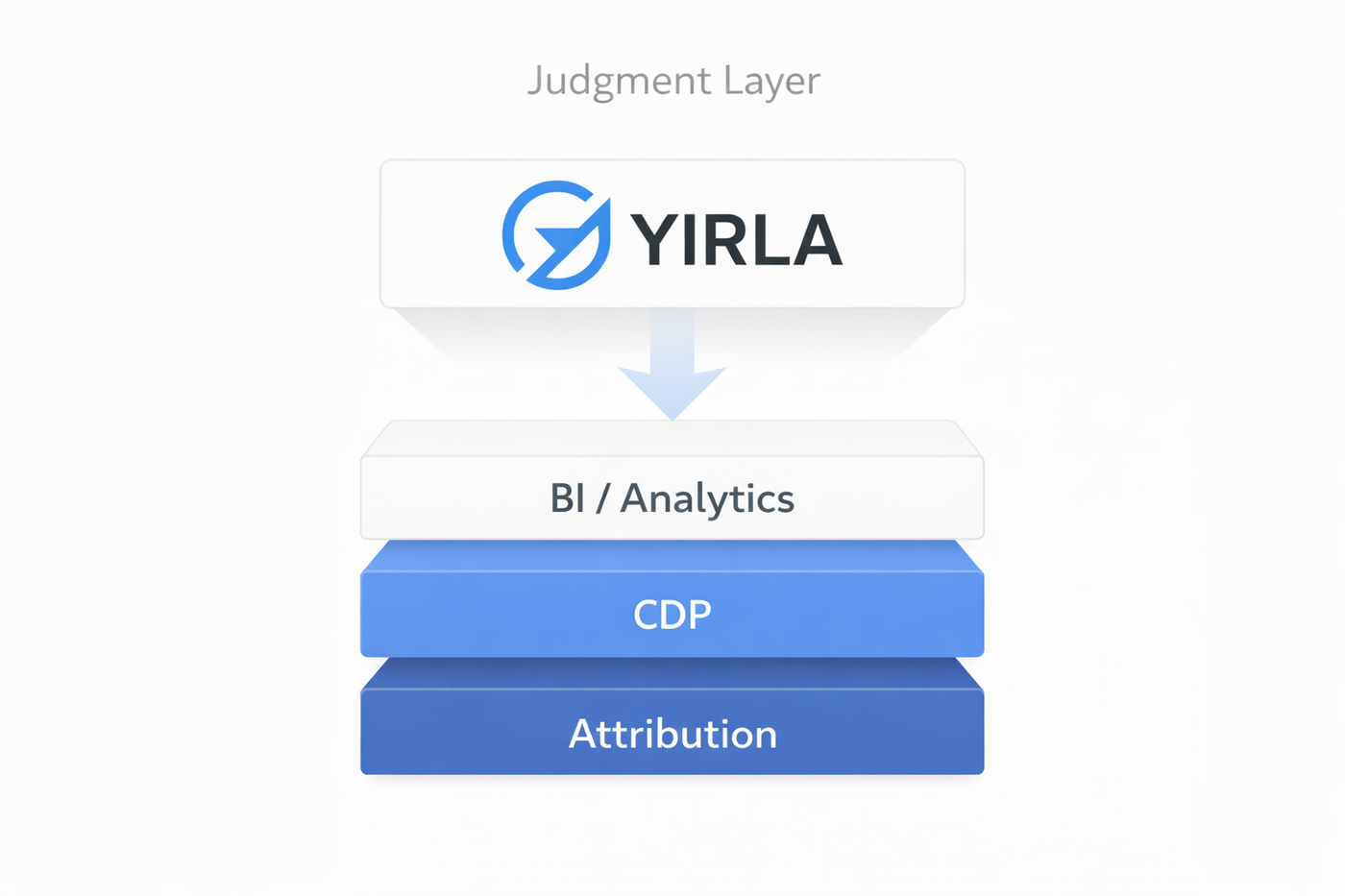
Yirla is a judgment layer. BI, CDPs, and attribution tools are infrastructure layers.
1. Why Yirla is not a BI tool
BI tools exist to answer:
“What does the data say?”
They are designed for:
dashboards
reporting
historical analysis
metric exploration
They assume:
clean, modeled data
agreed-upon definitions
analysts as primary users
time to explore and interpret
Yirla does not compete here. Yirla does not try to be:
Looker
Tableau
Mode
Power BI
Instead, Yirla exists because dashboards don’t make decisions. When spend is active, the question is not “What does the chart show?” It is “What should we do now?”
Yirla focuses on synthesis, prioritization, and early signals—so humans don’t have to interpret dozens of charts under time pressure.
2. Why Yirla is not a CDP
CDPs exist to answer:
“Who is this user or account, and how do we activate them?”
They are designed for:
identity resolution
profile unification
audience activation
personalization workflows
They assume:
long-lived user identities
first-party data ownership
downstream activation systems
Yirla does not unify identities or manage profiles. That is intentional. Yirla assumes the platforms already handle targeting and delivery. The hard problem is not activation—it is evaluation.
Yirla focuses on:
message effectiveness
creative performance
spend efficiency
saturation and decay
Those questions exist above identity resolution.
3. Why Yirla is not an attribution platform
Attribution platforms exist to answer:
“Which touches influenced pipeline or revenue?”
They are designed for:
credit assignment
funnel analysis
revenue reporting
sales–marketing alignment
They assume:
probabilistic models
delayed outcomes
post-hoc analysis
debate over credit
Yirla does not assign credit.
Yirla focuses on consequence, not contribution.
Attribution explains who to thank. Judgment determines what to change. By the time attribution is clear, the opportunity to act has often passed.
4. The gap these tools leave behind
BI tools explain the past. CDPs activate audiences. Attribution tools assign credit.
None of them answer this question well:
“Given everything we’re running right now, what should we stop, fix, or reallocate before more money is spent?”
That is the gap Yirla fills.
5. What Yirla actually is
Yirla is a judgment and decision intelligence platform for paid media.
It is built to:
synthesize performance across platforms
detect creative fatigue and message saturation
surface early warning signals
guide budget and execution decisions while they still matter
Yirla sits above execution, analytics, and attribution—not in place of them.
Final takeaway
BI tools analyze. CDPs activate. Attribution tools explain.
Yirla decides. That is why it is different—and why it exists.