Which Creatives Are Fatiguing — and How Do We Know Before Performance Drops?
The Creative Fatigue Paradox: Why Your Best-Performing LinkedIn Ads Are Quietly Dying
The Myth That's Costing You Thousands
Here's the biggest misconception in B2B advertising: Creative fatigue starts when CTR drops.
It doesn't. By the time your click-through rate shows decline, fatigue has already set in—and you've already overspent. Most demand generation teams react two to four weeks too late, watching their dashboards for the wrong signals while invisible pipeline decay accumulates beneath the surface metrics.
The real cost of creative fatigue isn't bad-looking ads or declining engagement rates. It's the systematic erosion of pipeline quality that happens silently, week after week, while your vanity metrics still look acceptable. This is a leading indicator problem masquerading as a creative problem, and the teams that figure this out gain a compounding advantage over those who don't.
What Creative Fatigue Actually Means
Strip away the subjective language about ads "feeling stale" or "looking tired." Creative fatigue is a precise, measurable phenomenon that occurs when three conditions converge:
First, your target audience has cognitively processed your message. They've seen it, understood it, and formed an opinion about it. Second, incremental exposure no longer increases persuasion. Additional impressions don't move them closer to action—they just reinforce existing beliefs. Third, the marginal return on each impression begins diminishing or even turning negative.
This is fundamentally a signal saturation problem, not an aesthetic one. Your creative hasn't become ugly or poorly written. It's simply exhausted its persuasive capacity within the addressable audience. The message has been received, processed, and either accepted or rejected. More exposure won't change the outcome.
Understanding this removes the subjective arguments about whether "the ad still looks good." It doesn't matter if the ad looks good. What matters is whether it's still discovering new demand or just recycling attention you've already captured.
Why CTR Is the Worst Early-Warning Signal
Most marketers watch CTR like a hawk, treating it as the primary indicator of creative health. This is precisely backward. CTR is a lagging indicator that only signals fatigue after significant damage has occurred.
Here's why: Click-through rate can remain stable—or even improve—due to habit clicks and familiarity bias. An audience that's seen your ad six or seven times may click more readily than an audience seeing it for the first time, simply because they recognize it. The ad feels familiar, safe, cognitively easy to process. This familiarity increases clicking behavior before it kills persuasion.
Think about it: You click on ads from brands you recognize all the time, even when you're not ready to buy. The click is low-commitment, requires minimal cognitive effort, and might satisfy mild curiosity. But that click doesn't represent intent. It represents familiarity.
This creates a dangerous paradox where engagement metrics remain healthy while conversion quality craters. Your CTR looks fine. Your CPC stays competitive. Lead volume holds steady. But underneath, the quality of those leads is degrading—fewer decision-makers, lower sales acceptance rates, worse downstream conversion. By the time CTR drops enough to trigger concern, you've been burning budget on low-quality engagement for weeks.
The Five Leading Indicators That Actually Matter
After analyzing creative performance patterns across 4.7 million LinkedIn ads from over 630,000 advertisers over the past three years, clear patterns emerge. Creative fatigue telegraphs itself through five distinct signals—all of which appear before CTR degradation becomes obvious.
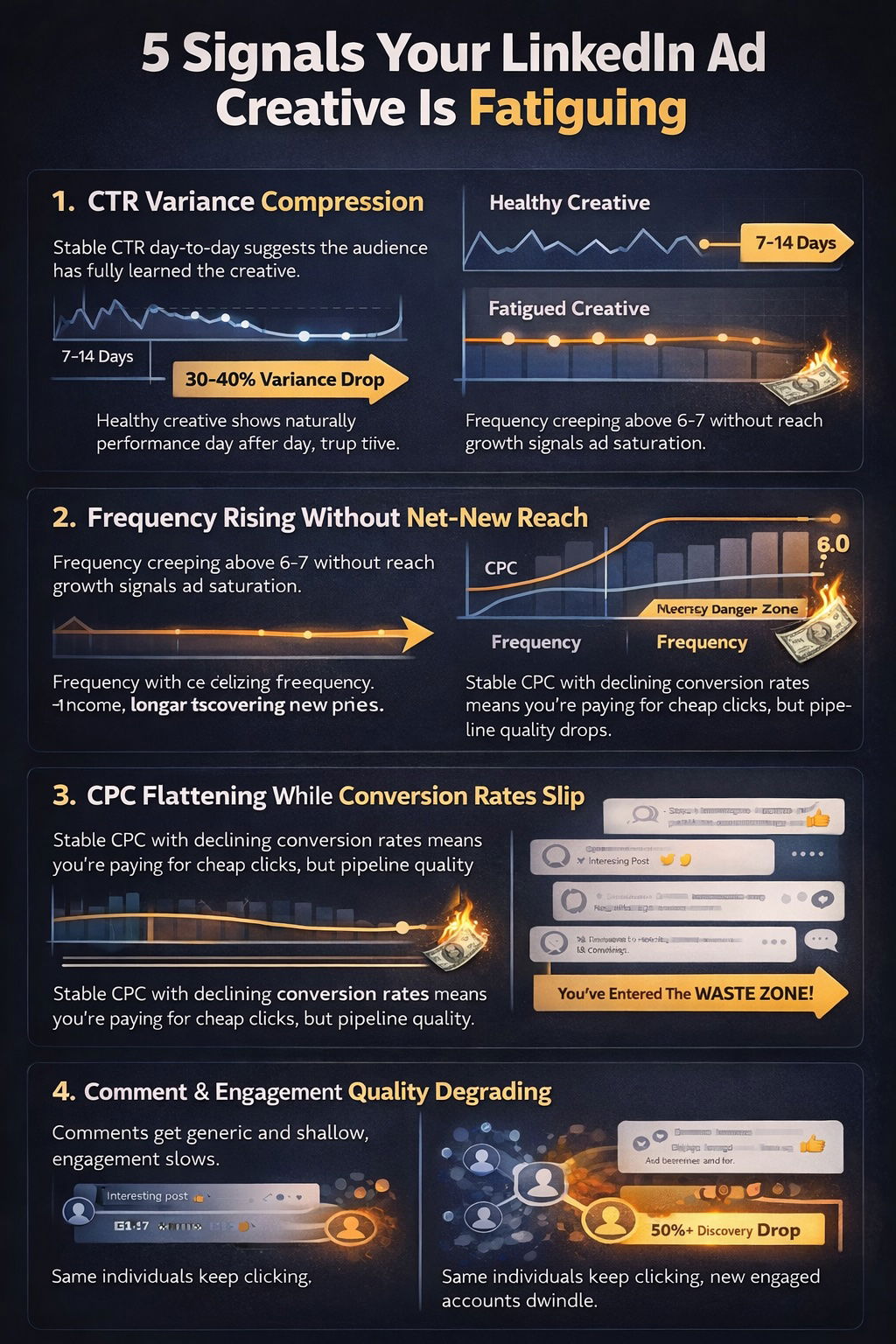
Signal One: CTR Variance Compression
Healthy creative shows natural performance variance day to day. Monday might deliver 0.9% CTR, Tuesday 1.1%, Wednesday 0.8%. This variance reflects the creative discovering different audience segments and response patterns across time and context.
Fatigued creative shows unnaturally stable performance. Day after day, CTR hovers between 0.95% and 1.05% with minimal movement. This plateau signals that the audience has fully learned the creative. Everyone who was going to respond has responded. The ad is no longer discovering new responders—it's recycling engagement from the same people.
When CTR variance drops by 30-40% over a seven to fourteen day window, you're looking at an early warning signal. Stable CTR isn't a win. It's often a warning that creative exhaustion is imminent.
Signal Two: Frequency Rising Without Net-New Reach
This is one of the most expensive fatigue signals to ignore, yet most teams don't monitor it until it's catastrophic. Watch what happens when frequency creeps above six or seven while reach growth slows: you're paying to re-show the same message to the same people who've already decided whether they're interested.
The math here is brutal. Each incremental impression to a saturated audience has near-zero persuasive value. You're not changing minds—you're just burning budget. When spend increases but unique reach does not, you've entered the waste zone. LinkedIn's algorithm continues delivering to "likely engagers"—the same people who clicked before but didn't convert—while your budget allocation follows engagement patterns rather than conversion potential.
Across our dataset, campaigns that exceed frequency 8.0 show conversion rates that are 60-75% worse than the same creative at frequency 2-4. Yet spend often continues for weeks because the engagement metrics look acceptable in aggregate.
Signal Three: CPC Flattening While Conversion Rates Slip
Here's a pattern that fools even sophisticated marketers: CPC appears healthy, perhaps even improving slightly, while post-click conversion rates decline quietly in the background. This divergence reveals that your creative is still attracting attention—just from the wrong people.
The clickers are less qualified now than they were four weeks ago. They're clicking out of familiarity or mild curiosity, not genuine buying intent. Your ad has become "interesting enough to click" but not "compelling enough to convert." This is the engagement trap in miniature: cheap clicks coexisting with expensive pipeline.
When we analyze conversion cohorts, creative that's been running 8+ weeks often shows 40-50% lower MQL-to-SQL conversion rates compared to the same creative in weeks 1-3, even when CTR and CPC remain stable. The platform metrics look fine. The business metrics are deteriorating.
Signal Four: Comment and Engagement Quality Degrading
This indicator is more qualitative than the others, but it's extremely predictive if you know what to look for. High-intent viewers engage differently than passive browsers. Early in a creative's lifecycle, you see thoughtful comments, specific questions, and genuine dialogue. People are processing your message seriously and responding with substance.
As fatigue sets in, engagement becomes shallower. Comments become generic ("interesting," "thanks for sharing," emoji reactions). Fewer people ask substantive questions. Engagement velocity—the speed at which people respond and how deep conversations go—slows noticeably.
This pattern appears because your creative has already reached the high-intent segment of your audience. They engaged weeks ago. Now you're reaching the periphery—people with passive interest but no buying urgency. They'll still engage casually, maintaining your engagement metrics, but they won't convert.
Signal Five: Account-Level Signal Density Declining
This is where creative fatigue becomes a revenue problem. In healthy campaigns, you see expanding signal density within target accounts. First one person clicks, then a colleague from the same account, then someone from a different department. This multi-stakeholder engagement is the leading indicator of buying committee formation.
Fatigued creative shows the opposite pattern: fewer new accounts engaging, the same accounts repeatedly interacting, and no expansion across buying committees. You're recycling attention from the same individuals who've already seen your message and formed an opinion. Demand is not renewing. Momentum is not building.
When new account discovery rates drop by 50% or more while overall engagement metrics remain stable, you're spending heavily against an exhausted audience pool. The creative has captured everyone it's going to capture. Continued spend is pure waste.
The Creative Lifecycle Curve Most Teams Misunderstand
Every creative follows a predictable lifecycle with four distinct phases: Discovery, Acceleration, Saturation, and Decay. Understanding where you are in this curve determines whether you're spending efficiently or burning budget.
During Discovery—typically the first two to three weeks—the creative is finding its audience. Performance is volatile as LinkedIn's algorithm tests delivery across segments. CTR might spike as you reach early adopters, then settle as the algorithm optimizes. This is the learning phase.
Acceleration comes next, usually weeks three through six. The algorithm has learned who responds, delivery becomes more efficient, and performance stabilizes at peak levels. This is your maximum efficiency window. CPL is lowest, conversion quality is highest, and you're reaching genuinely net-new demand.
Saturation begins around week six to eight. Frequency starts climbing. New account discovery slows. Performance remains acceptable in aggregate but efficiency is declining at the margins. You're spending more to reach less incremental value. This is the danger zone where most teams keep spending because the dashboard still looks okay.
Decay follows saturation if you don't intervene. CTR drops, CPC rises, conversion quality collapses. By the time you're in Decay, you've already lost weeks of efficient spend during Saturation that should have been reallocated.
Here's the insight most teams miss: the goal is not to extend creative life forever. The goal is to exit at saturation—before decay begins. The money is lost during late-stage Saturation when metrics look fine but efficiency is quietly dying.
Why "Refreshing Creative" Usually Fails
When teams finally notice fatigue, the instinct is to "refresh" the creative. They swap the hero image, tweak some copy, maybe change the CTA button color. Then they relaunch and wonder why performance doesn't improve.
The problem: fatigue is about message exhaustion, not creative assets. If you swap a blue background for a green background but keep the same value proposition, the same positioning, and the same core promise, fatigue persists. Your audience hasn't forgotten your message because the visual changed. They've already processed it and decided.
Effective creative rotation requires changing the underlying message: different pain points, different outcomes, different proof points, different audience assumptions. You're not tweaking the wrapper—you're changing what's inside.
Our data shows that cosmetic refreshes (new images, minor copy edits) extend creative life by an average of 1.8 weeks. Message-level refreshes (new positioning, different value prop) reset the lifecycle curve entirely, delivering 6-8 weeks of renewed efficiency.
What High-Performing Teams Do Differently
The teams that manage creative fatigue effectively don't optimize harder—they operate differently at a system level. They've built infrastructure that makes fatigue visible and actionable.
First, they monitor leading indicators, not just CTR. They track variance compression, frequency dynamics, account-level signal density, and conversion quality cohorts. They see fatigue coming weeks before it appears in engagement metrics.
Second, they separate creative learning from performance optimization. Early in a creative's life, they're learning what resonates. Late in its life, they're extracting maximum value before retirement. These require different optimization approaches and different KPIs.
Third, they rotate messages, not just ads. Their creative pipeline includes fundamentally different positioning approaches, not just variations on the same theme. They're ready to shift the conversation when saturation appears.
Fourth, they treat creative as a portfolio with lifecycle states. Some creative is in Discovery (learning), some in Acceleration (scaling), some in Saturation (harvesting), and some in Development (being created). Budget flows toward Acceleration, gets conserved during Saturation, and pulls from Development as needed.
This isn't about clicking buttons in Campaign Manager. It's about building organizational capabilities that make fatigue manageable rather than catastrophic.
The Question You Should Be Asking
Instead of asking "Is this creative still working?" the better question is: "Is this creative still discovering new demand?"
A creative can be "working" in the sense that it generates clicks and leads while simultaneously being fatigued in the sense that it's no longer reaching net-new buyers or building new pipeline. Working and efficient are not the same thing.
When creative is still discovering demand, you see expanding reach, new account engagement, multi-stakeholder signals, and improving conversion quality cohorts. When creative is fatigued, you see recycled attention, stable volume with declining quality, and saturation signals across your audience pool.
The distinction determines whether your next dollar of spend generates new pipeline or just creates more of the same low-quality engagement you've already captured.
Fatigue Isn't Failure—It's Proof the Creative Did Its Job
Here's the reframe that changes how you think about this: creative fatigue isn't a sign you did something wrong. It's proof the creative did its job. It reached your audience, delivered your message, and captured everyone it was going to capture.
Now it's time to move on.
The teams that win aren't the ones with creative that never fatigues. They're the ones who see fatigue clearly, exit efficiently, and rotate to new messages before waste accumulates. They understand that creative has a natural lifecycle, and fighting that lifecycle is expensive.
Your ad didn't fail. It succeeded. And success in advertising is temporary by nature. The question is whether you have the systems to see when success is ending and the discipline to move on before it becomes waste.
That's the difference between teams that scale efficiently and teams that keep spending against exhausted signals because their dashboards haven't told them to stop yet. By the time the dashboard catches up, it's already too late.